

Cibolo is one of the fastest-growing cities in the entire state of Texas. Drive east out of San Antonio on I-10 or FM 78, and the pace of construction in the northeastern suburbs — Cibolo, Schertz, Universal City, and their surrounding communities — is impossible to miss. New subdivisions are going up on what was farmland. Established neighborhoods are turning over fast. And buyers from across the country are arriving in this market with competitive offers and tight timelines.
That combination — rapid growth, competitive conditions, and buyers unfamiliar with South Texas homes — is exactly why the home inspection matters so much here, and why it matters who you hire.
Rod Stewardson at Rod Inspects is a TREC-licensed home inspector based in Cibolo. He inspects homes throughout the San Antonio northeastern suburbs every week. This guide explains what August buyers in Cibolo and Schertz need to know about the inspection process — and why summer conditions in this specific market create risks that inspectors from outside the region may not be equipped to evaluate.
What Inspectors Actually Find in Cibolo and Schertz Homes
The northeastern San Antonio suburbs contain a genuine mix of housing stock: older rural properties in unincorporated Guadalupe County, mid-2000s master-planned community homes in established Cibolo neighborhoods, and a steady stream of new construction across current active subdivisions in both cities.
Each type carries its own inspection profile.
Older rural properties in this corridor frequently present aging septic systems, well infrastructure in various states of maintenance, and deferred exterior upkeep on masonry or stucco finishes. These homes often have the most acreage and the most unknowns.
Mid-2000s homes in Cibolo and Schertz were built during a construction boom that produced solid volume — and in some cases, rushed framing, undersized HVAC systems for the square footage they were installed in, and drainage grading that has shifted over two decades of South Texas wet-dry cycles. These homes are now approaching the age where original HVAC systems, water heaters, and roofing are entering their replacement window.
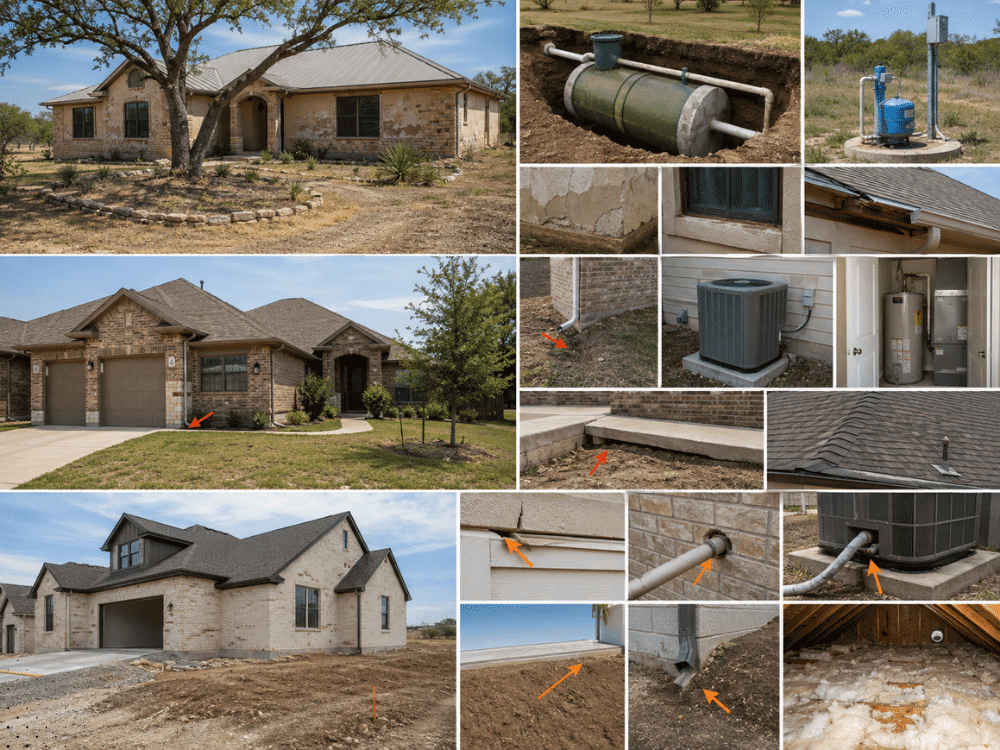
New construction is where the current risk concentration is highest. The speed of the Cibolo and Schertz building market means individual crews are moving from lot to lot under pressure. Rod finds grading and drainage deficiencies on new builds, exterior envelope gaps that allow moisture and pest intrusion, HVAC installation errors, and attic insulation coverage issues that fail Texas energy code — but pass without a close look. New does not mean defect-free.
For buyers purchasing newer properties, a professional Buyer Home Inspection can provide an independent evaluation before closing and help identify items that may need attention before ownership begins.
Why August Is the Most Revealing Time to Inspect a Home in This Market
August in the San Antonio northeastern suburbs is not a comfortable month to be outside. Temperatures regularly exceed 100 degrees Fahrenheit, and the combination of radiant heat, humidity, and virtually no cloud cover creates conditions that stress every major system in a home simultaneously.
That stress is visible to an inspector who knows what to look for.
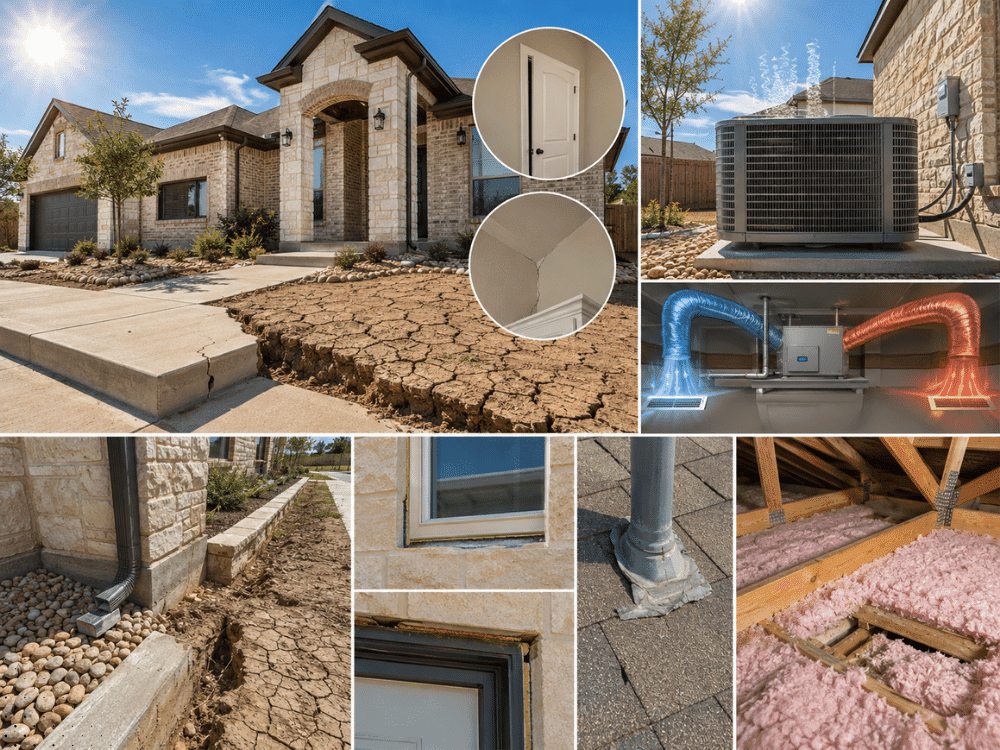
Foundation: August is typically the driest month of the year in the Guadalupe County corridor. The expansive clay soils that underlie most of this region reach their lowest moisture content in late summer. When clay dries, it contracts — and as it contracts, it pulls away from slab edges and piers. This is the time of year when foundation movement is most pronounced and most visible. Door frames that stick or gap, floor areas that slope, and drywall cracks at door and window corners are all August-condition indicators. Some movement is cosmetic; some requires engineering review. The only way to know which is which is to document it.
HVAC: An air conditioning system under August load in Cibolo or Schertz is running at its maximum stress point. A unit with a marginal compressor, a coil approaching the end of its service life, or ductwork that was never sized correctly will show its limitations clearly in August heat. Rod performs a temperature differential test on every system — measuring the temperature of return air going in versus supply air coming out. A healthy system produces a consistent split. A failing one does not. August is the best month on the calendar to catch a unit that is running but degrading.
New construction defects: Heat stress also reveals building envelope failures. Expanding and contracting materials in extreme summer temperatures expose gaps around windows and doors, sealant failures at roof penetrations, and attic insulation that was installed with voids or compression that won’t be obvious in cooler weather.
The New Construction Problem in Fast-Growing Communities
Cibolo and Schertz are among the highest-volume residential construction markets in the San Antonio metro. Guadalupe County has been one of the fastest-growing counties in Texas for several consecutive years, and that growth has translated into a building pace that places real pressure on quality control at the individual home level.
Texas law does not require builders to provide a third-party inspection before closing. Builder inspectors are employed by or contracted through the builder — they are not working for you. New construction buyers who waive an independent inspection have no independent verification of what they are receiving.
A professional Buyer’s Inspection can help buyers better understand the condition of a property before closing, including visible structural components, installed systems, and construction details that may need additional review.
Common new construction findings in this market include:
- Drainage grading that directs water toward the foundation rather than away from it — one of the most common and consequential defects in new builds
- Attic insulation gaps or compression at eave lines that violate energy code thresholds
- HVAC register placement and duct sizing errors that create uneven cooling across the home’s square footage
- Exterior envelope gaps at window and door frames, utility penetrations, and brick-veneer weep holes that are absent or blocked
- Missing or improperly installed flashing at roof-to-wall intersections
None of these are exotic or rare findings. They show up on new construction inspections in Cibolo and Schertz with regularity. Catching them before closing gives buyers the leverage to have the builder correct them at no cost — leverage that disappears at the moment you sign.
Questions Cibolo Home Buyers Ask About Inspections
Q: What does a home inspector look for in Cibolo TX that is specific to this area?
A TREC-licensed home inspector in Cibolo TX evaluates foundation condition on expansive clay soils (the dominant soil type in Guadalupe County), HVAC performance under extreme South Texas summer heat loads, drainage grading around the slab perimeter, and — on properties outside municipal sewer — septic system type and access. New construction inspections in Cibolo and Schertz additionally focus on builder envelope quality, attic insulation coverage, and drainage grading that is frequently deficient on freshly graded lots.
Q: Do I need a home inspection on a new construction home in Cibolo or Schertz TX?
Yes. New construction homes in Cibolo and Schertz TX require an independent home inspection before closing. Builder inspectors are not working on your behalf. Independent inspections routinely find drainage grading deficiencies, HVAC sizing errors, attic insulation gaps, and exterior envelope defects on new builds in fast-growing Texas suburban markets. Identifying these items before closing gives buyers the right to require correction at the builder’s expense — a right that ends at the closing table.
Q: Why do foundations move so much in the San Antonio northeastern suburbs?
Foundation movement in Cibolo, Schertz, and the broader San Antonio northeastern suburbs is driven by expansive Guadalupe County clay soils that swell when wet and contract when dry. The extreme wet-dry cycles of South and Central Texas — wet springs followed by dry August conditions — create seasonal movement in slab foundations. Homes with inadequate perimeter drainage, tree root proximity, or poor original grading experience more movement over time. A home inspector documents signs of differential settlement and can recommend a structural engineer evaluation when findings warrant it.
Q: How does extreme summer heat affect the home inspection in the San Antonio suburbs?
August in the Cibolo and Schertz area is the single most revealing time to inspect an HVAC system, because every unit is running at maximum load. A temperature differential test performed during peak August heat will expose a marginal compressor, undersized equipment, or ductwork distribution problems that would be easy to miss in cooler months. August also corresponds to peak soil dryness — when expansive clay reaches its minimum moisture content and foundation movement indicators are most visible on slab homes.
Rod also uses advanced inspection tools when appropriate. Learn more about our Infrared Thermal Inspection services and how thermal imaging can help identify temperature differences that may require further evaluation.
Q: How do I find a licensed home inspector in Cibolo TX?
To find a licensed home inspector in Cibolo TX, verify that your inspector holds a current Texas Real Estate Commission (TREC) license — Texas law requires all home inspectors to be TREC-licensed. You can confirm license status through the TREC public license lookup at trec.texas.gov. Rod Stewardson at Rod Inspects is a TREC-licensed inspector based in Cibolo who serves buyers throughout Guadalupe County, Bexar County, and the San Antonio northeastern suburbs.